Service Dogs in Nevada: Training, Access Rights and Where to Start
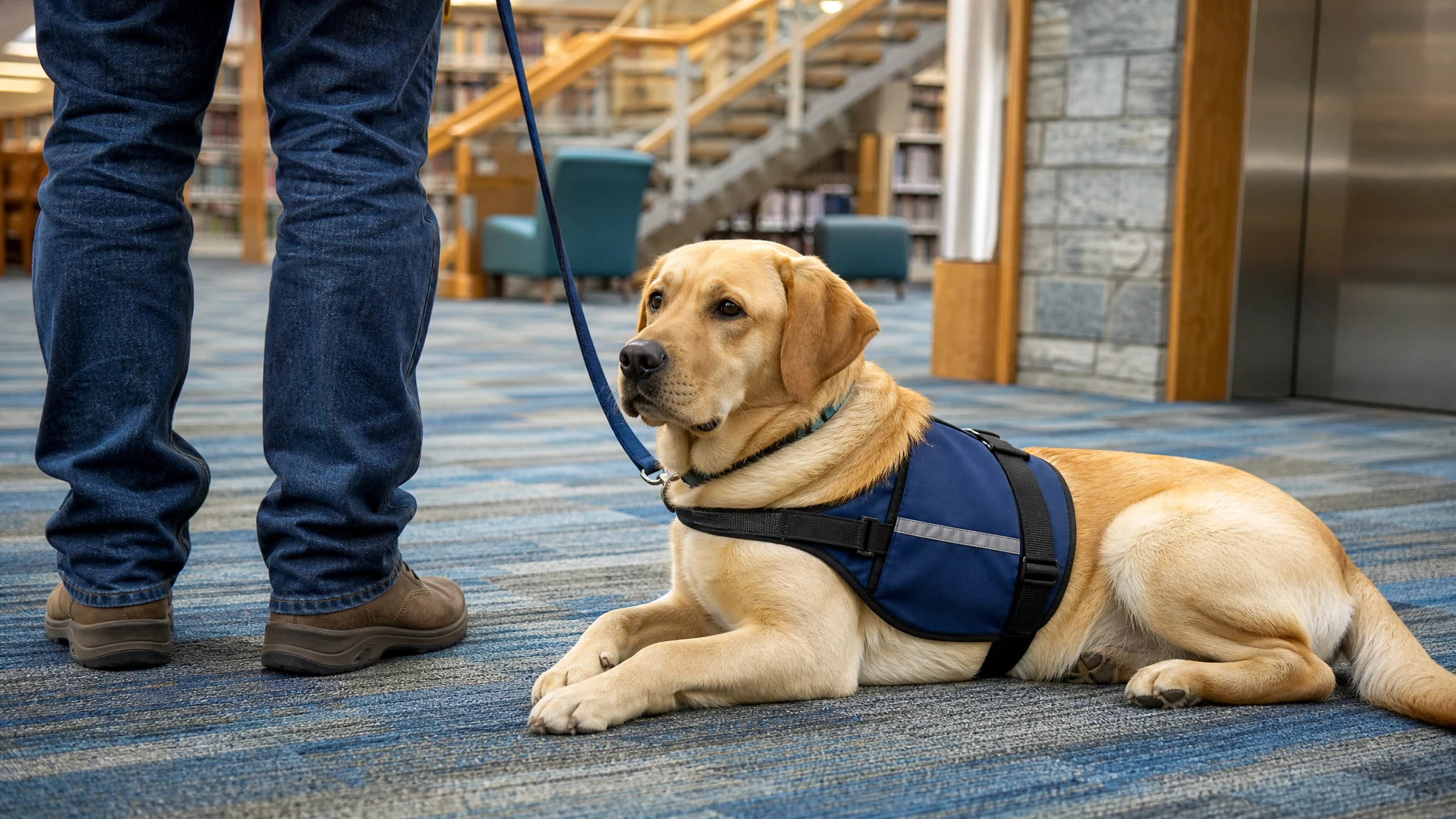
This page explains the law in general terms. It is not legal advice. For a specific situation, contact the agency listed on this site or an attorney.
If you live with a disability and are thinking about a service dog in Nevada, the first questions are usually practical. Who qualifies? What does the law actually protect? Do you apply to a program or train the dog yourself? And what, if anything, has to be registered?
This guide answers those questions in plain English. It covers the federal definition under the Americans with Disabilities Act (ADA), what Nevada law adds, the two routes to a working dog, what training involves, how to think about cost, and the Nevada organizations worth contacting first. It is not legal advice. For complaints and rights questions, the agencies named below are the right place to go.
Contents
- Key takeaways
- What counts as a service dog in Nevada
- Your access rights under Nevada law and the ADA
- How to get a service dog in Nevada: the two routes
- What service dog training involves
- Nevada organizations to know
- Costs, planning and where to start
- Sources
Key takeaways
- Under the ADA, a service animal is a dog that has been individually trained to do work or perform tasks for an individual with a disability (ADA.gov).
- Emotional support, therapy and comfort animals are not service animals under the ADA.
- There is no official service dog registry or required certification under the ADA, and Nevada has no state service dog ID program. You do not need to register or certify a dog.
- Nevada's public accommodation law, NRS 651.075, goes further than the ADA. It also covers service animals in training and bars businesses from requiring proof.
- Businesses may not charge an extra fee or deposit because of a service animal.
- You can pursue a dog through a program or train your own. Both routes take sustained, reward-based work.
- Costs and waitlists vary by organization. Ask each one directly, because no verified figures are available here.
What counts as a service dog in Nevada
The federal definition
ADA.gov defines a service animal as a dog that has been individually trained to do work or perform tasks for an individual with a disability. Two parts of that sentence matter most: the dog is individually trained, and the training is tied to the person's disability.
The work or tasks must be real and specific. A dog might be trained to alert to a change, retrieve an item, interrupt a harmful behavior, or provide a steadying brace. A dog that simply makes someone feel better by being nearby does not meet the definition on that basis alone.
How Nevada defines it
Nevada's statutes build on the federal rule. According to the Nevada Legislature's NRS Chapter 426, NRS 426.097 defines service animal by reference to the federal regulation at 28 CFR 36.104, and it adds miniature horses that are trained to do work or perform tasks.
NRS 426.099 defines a service animal in training as a dog or miniature horse that is being trained as a service animal. This is an important Nevada feature, and it comes up again below.
What is not a service dog
The ADA draws a clear line here, and keeping it exact protects you. Emotional support animals, therapy animals and comfort animals are not service animals under the ADA.
- Service dog: individually trained to do work or tasks for a person with a disability.
- Therapy dog: typically visits others, such as patients in a facility, rather than assisting one handler with a disability.
- Emotional support or comfort animal: provides companionship or comfort, without the task training the ADA requires.
Housing and employment can follow different rules, which are covered below. Public access under the ADA turns on the task-trained service dog definition.
No registry, no certificate
There is no official service dog registry or required certification under the ADA. Nevada also has no state service dog ID or registry program that turned up in the research behind this guide.
Websites that sell registrations, ID cards, vests with certificates or "official" papers are not issuing legal proof of anything. You do not need to buy one, and you should not treat one as a legal document. What makes a dog a service dog is its training and its job, not a card.
Your access rights under Nevada law and the ADA
Public places
Nevada's main public access statute is NRS 651.075, found in the Nevada Legislature's NRS Chapter 651. Its core rules are:
- A place of public accommodation may not refuse admittance or service to a person with a disability because of a service animal.
- It may not charge an additional fee or deposit for the animal.
- It may not require proof that the animal is a service animal.
Staff are still allowed to ask two things. The ADA.gov service animal FAQ lists them as: (1) Is the dog a service animal required because of a disability? (2) What work or task has the dog been trained to perform? NRS 651.075 likewise allows staff to ask whether the animal is a service animal and what tasks it is trained to perform.
Staff may not ask for paperwork, a demonstration or details of your diagnosis. A short, calm answer to the two questions is what the law contemplates.
When a dog can be removed
Access is not unlimited. Under NRS 651.075, staff may remove an animal that is out of control or that poses a direct threat. A service animal also may not be presumed dangerous just because it is not muzzled.
Handlers remain liable for damage the animal causes. Good training and good handling protect your access as much as the statute does.
Service animals in training
This is where Nevada goes beyond the ADA. NRS 651.075 bars refusing admittance or service to a person who is training a service animal and is accompanied by a service animal in training. It also covers an employee who is training a service animal in training.
The statute text reviewed for this guide states no age, harness or ID conditions for these trainers, and it bars requiring proof that an animal is a service animal in training. NRS 426.510(7) also exempts anyone training a service animal from that section's use restriction.
The ADA covers only dogs, plus miniature horses under separate provisions. Nevada's in-training protection is therefore a real advantage for owner-trainers and program trainers, who need public practice to proof their dogs.
Miniature horses
Nevada law includes miniature horses trained to do work or perform tasks. A business may refuse a miniature horse, including one in training, if it determines compliance is not reasonable. NRS 613.330 applies the same "not reasonable" exception for employers. If you are considering a miniature horse, confirm the details with the Nevada Equal Rights Commission before relying on access.
Housing
According to the Nevada Legislature's NRS Chapter 118, NRS 118.105 says a landlord may not refuse to rent a dwelling to a person with a disability solely because an animal that assists, supports or provides service to the person will reside there. The landlord may require proof, and a statement from a health care provider may satisfy that.
Notice the difference from public places. In housing, proof can be requested. Federal housing rules from HUD also apply, so check with HUD or the Nevada Equal Rights Commission if you hit a problem.
Work
NRS 613.330(6), in the Nevada Legislature's NRS Chapter 613, makes it an unlawful employment practice to refuse to permit an employee with a disability to keep the employee's service animal at all times in the workplace. NRS 613.330(5) bars interfering with the use of an aid or appliance, including a service animal.
Penalties and protections in Nevada
Nevada backs these rules with consequences, and they run in both directions.
- Business violations: Under NRS 651.075, a fee or deposit violation carries actual damages, punitive damages of up to 3 times actual damages (minimum $750) and attorney's fees.
- Interfering with a service animal: Per the notes from NRS 426.790, interference is a gross misdemeanor. Beating a service animal is a category E felony, and killing one is a category D felony.
- Misrepresentation: NRS 426.805 makes misrepresentation a misdemeanor with a fine of not more than $500. Passing off a pet as a service animal harms people who rely on genuine ones.
Civil remedies appear in NRS 426.820.
Where to complain
Public accommodation complaints under NRS 651.110 go to the Nevada Equal Rights Commission (NERC), part of the Department of Employment, Training and Rehabilitation. Its page is at detr.nv.gov. Confirm current contact details and any filing deadline directly with NERC, since those should not be assumed.
How to get a service dog in Nevada: the two routes
People asking how to get a service dog in Nevada generally end up choosing between two paths. Neither is a shortcut, and neither requires a government application or a certificate.
Route one: a program-trained dog
In this route a nonprofit or training organization selects, raises and trains the dog, then matches it with a handler. The organization usually handles the early training and the matching process, and often provides instruction for the handler.
Strengths of this route include structured training and support from people who have done it before. The tradeoffs are eligibility rules, application steps and, in many cases, waiting. Waitlists and costs vary widely, and no verified numbers for Nevada programs are available here, so ask each program.
Questions to ask any program:
- Who does the program serve, and what disabilities or conditions does it work with?
- What does it cost the applicant, if anything, and what ongoing costs should I expect?
- How long is the waitlist?
- What training methods does it use? Look for humane, reward-based methods.
- What happens if the match does not work out?
- What support continues after placement?
Route two: an owner-trained dog
In this route you train the dog yourself, sometimes with help from a trainer or class. Nothing in the ADA requires a professional program. The legal test is the same: the dog is individually trained to do work or perform tasks related to your disability.
Owner training offers control over the process and the timeline. It also asks a lot. You need time, consistency, a dog with a suitable temperament and a willingness to quit with a dog that is not suited to the job. Not every dog can become a service dog, even with excellent training.
Nevada's in-training protection under NRS 651.075 helps here, because a service animal in training is covered in places of public accommodation. That makes real-world practice more feasible. Pair that with courtesy and good judgment, since staff can still remove a dog that is out of control.
Choosing between them
Consider your health, your energy, your budget and your experience with dogs. Some people use a hybrid: they train the dog at home and add classes or private coaching for specific skills. Others apply to a program and wait while building basic dog-handling skills.
Whichever you choose, talk with your health care provider about how a service dog fits into your care. Whether you have a disability that a service dog could help with is a decision for you and your provider, not for a website.
What service dog training involves
Training does not follow one legally mandated curriculum. The ADA sets the outcome, a dog individually trained to do work or perform tasks, not the method or the number of hours. What follows is a general overview of how reputable trainers approach the work.
Humane, reward-based methods
Responsible training follows the position of the American Veterinary Society of Animal Behavior (AVSAB): reward-based methods. That means marking and rewarding behavior you want, using food, toys or praise, and managing the environment so the dog succeeds.
Shock, prong and choke collars, alpha rolls, scruffing and dominance methods are not part of humane training. They can increase fear and stress, and a stressed dog is a poor candidate for public work. If a trainer or program recommends them, look elsewhere.
Stage one: foundations
Every service dog needs a solid base. This usually includes house manners, loose-leash walking, a reliable recall, settling quietly, and calm responses to new people, noises and surfaces. Early socialization means safe, positive exposure to everyday life. It does not mean forcing a nervous dog into overwhelming situations.
Stage two: public access skills
Next comes learning to work in public. The dog should stay focused on its handler, ignore food on the floor, tolerate crowds and settle under a table or beside a chair. This is the stage where Nevada's in-training provision is useful, since practice outings in stores and other public places are part of the process.
Stage three: task training
Task training is what turns a well-behaved dog into a service dog under the ADA. The tasks depend on the handler's disability and needs. Trainers usually break each task into small steps, reward each step, then build duration, distance and distraction.
Be specific about what your dog does. The second permitted question, "What work or task has the dog been trained to perform?", is easiest to answer when you can name the tasks in a sentence.
Ongoing maintenance
Training does not end on a graduation day. Skills fade without practice, and life changes. Plan for regular refreshers, veterinary care and a point at which the dog retires. Watching your dog for signs of stress or discomfort is part of the job.
Working with a trainer
If you hire a trainer, ask about methods first. Ask what they do when a dog struggles, and ask how they handle disability-specific tasks. Be cautious about anyone who promises results or offers a certificate as proof of legal status. No such certificate exists under the ADA.
Nevada organizations to know
The programs below are starting points, not recommendations or rankings. Details come from each organization's own materials or the listings noted, and anything marked unknown should be confirmed directly. Check eligibility, costs and waitlists with each one.
Liberty Dogs, Reno
Liberty Dogs, run by the Dave & Cheryl Duffield Foundation, is a national Veteran service dog training and placement program based in Reno for U.S. military Veterans living with PTSD. According to its website, services are at no cost to the Veteran, and the program includes a two-week on-campus stay to train with the dog.
The campus is at 1215 Damonte Ranch Parkway, Reno, and the site lists its opening as Summer 2026. Check the current status and the application process on the site: libertydogs.org. Waitlist information is not listed there, so ask.
Michael's Angel Paws, Las Vegas
Michael's Angel Paws is a Las Vegas nonprofit. Its Service Dog Program is described as a 52-week journey covering public access and task training, and it also fields therapy dog teams. A Nevada volunteer listing says it was incorporated in October 2012 and has graduated over 125 assistance dogs. Cost and waitlist details are not published in the sources reviewed, so ask the organization: michaelsangelpaws.org.
Military Animal Project, Reno
The Military Animal Project's northern Nevada chapter serves veterans with PTSD and related conditions. Its Idealist listing describes emotional support or psychiatric service dogs, certified therapy dog visits and an Equine Buddies Program, and says all services are provided at no cost to the Veteran. That information comes from the directory listing, so confirm it with the organization at militaryanimalproject.com.
Note that the organization lists emotional support dogs among its offerings. Those are not the same as ADA service dogs, so ask how each type of dog is trained and what access rights apply.
Silver State Service Dogs Inc., Henderson
A directory profile describes Silver State Service Dogs as an all-volunteer organization that breeds, raises and trains service dogs for disabled veterans. The profile is the only description available here, so contact the organization to confirm services, costs and waitlists. Its profile is at Benevity.
Those Left Behind (Pups, Prisoners and Patriots), Las Vegas
The Nevada Independent describes Those Left Behind as a Las Vegas nonprofit that partners with Lovelock Correctional Center, where inmates train rescued dogs for veterans and first responders. The Nevada Independent describes them as emotional support dogs, while KTNV says the group pairs service dogs with veterans and elderly people in need. Because the wording differs, ask the organization what training the dogs receive and whether they are task-trained. No website was given in the coverage. Read the report here: The Nevada Independent.
VA facilities in Nevada
Two VA pages are worth knowing, though neither places dogs. The VA Sierra Nevada Health Care System runs a pet therapy program in which certified therapy dogs visit Veterans, especially in the Community Living Center. That is therapy dog visiting, not service dog placement. See Canine Comfort for Our Veterans.
The VA Southern Nevada Healthcare System explains its service dog policy. Veterans with service dogs are welcome in all areas where patients are normally allowed, except places such as surgical suites. The page also says dogs in training are not service animals. See Understanding the VA service dog policy.
A note on what is not confirmed
Several details could not be confirmed for this guide, including which Nevada groups are accredited by Assistance Dogs International, and the costs and waitlists of most programs. Treat any claim you cannot verify with caution, and ask each organization to put its answers in writing.
Costs, planning and where to start
Thinking about cost
No verified Nevada cost figures are available for this guide, so no dollar amounts are given. What can be said is how costs tend to be structured.
- Program-trained: Some programs place dogs at no cost to the handler, as Liberty Dogs and the Military Animal Project state for Veterans. Others may charge fees or ask for fundraising. Ask each program for its current terms.
- Owner-trained: You pay as you go for the dog, veterinary care, equipment, classes and any private coaching.
- Ongoing costs either way: Food, veterinary care, grooming and supplies continue for the dog's whole life.
Be wary of anyone asking for large payments for "registration" or "certification." Nevada law does not require either, and a business cannot demand proof from you in a public place.
A practical starting plan
- Talk with your health care provider. Discuss how a trained dog might help with your specific needs, and which tasks would matter most.
- Learn the legal definition. Read the ADA.gov service animal FAQ at ada.gov so you can recognize accurate and inaccurate claims.
- Pick a route. Decide whether you want to apply to a program, train your own dog, or combine both.
- Contact organizations. Use the list above and ask the questions from the program section. Get costs, timelines and eligibility rules in writing.
- Vet trainers and methods. Choose humane, reward-based approaches in line with AVSAB. Walk away from anyone using aversive tools.
- Plan for public practice. Use Nevada's in-training protection thoughtfully, with a dog that is under control, and be ready to answer the two permitted questions briefly.
- Know where to turn. If you are refused access or charged a fee, contact the Nevada Equal Rights Commission.
Common questions
Do I need to register my service dog in Nevada? No. There is no official registry or required certification under the ADA, and no Nevada state ID program turned up in the research for this guide.
Can a restaurant or store ask for proof? Under NRS 651.075, no. Staff may ask the two questions about whether the dog is a service animal and what tasks it is trained to perform.
Can they charge a pet fee? No. NRS 651.075 bars additional fees or deposits for a service animal in places of public accommodation.
Is an emotional support dog a service dog? Not under the ADA. Emotional support, therapy and comfort animals are not service animals under federal law.
Can I train my own service dog? The ADA does not require a professional program. The dog must be individually trained to do work or perform tasks for you, and Nevada's public access law also covers service animals in training.
Does the dog have to wear a vest? The statute text reviewed for this guide sets no vest or ID conditions for service animals in training. For other situations, confirm with the Nevada Equal Rights Commission.
A final word
Getting a service dog in Nevada is mostly about training and honest matching, not paperwork. Know the definition, know your rights, and be careful about who you trust with the work. If you are unsure about a specific situation, the agencies and statutes below are the places to check.
Sources
- ADA.gov, Frequently Asked Questions about Service Animals and the ADA
- Nevada Legislature, NRS Chapter 651 (public accommodations, NRS 651.075 and 651.110)
- Nevada Legislature, NRS Chapter 426 (definitions, interference and misrepresentation)
- Nevada Legislature, NRS Chapter 118 (housing)
- Nevada Legislature, NRS Chapter 613 (employment)
- Nevada Equal Rights Commission
- Liberty Dogs
- Michael's Angel Paws
- Military Animal Project
- VA Sierra Nevada Health Care System, Canine Comfort for Our Veterans
- VA Southern Nevada Healthcare System, service dog policy