Service Dog Tasks and the Public Access Test, Explained
This page explains the law in general terms. It is not legal advice. For a specific situation, contact the agency listed on this site or an attorney.
Two ideas sit at the center of service dog training: the work the dog does for its handler, and how the dog behaves in public. People often mix them up, or assume a test or a certificate decides whether a dog is a service dog.
It does not. This guide explains what counts as a task, how to train one step by step, and where the public access test fits. It also covers what Nevada law says about access, so you know your rights before you walk into a store.
What Counts as a Service Dog Task
ADA.gov defines a service animal as a dog that has been individually trained to do work or perform tasks for an individual with a disability. Two parts of that sentence matter most: the training is individual, and the work relates to the person's disability.
Nevada uses the federal definition. NRS 426.097 refers to the federal rule at 28 CFR 36.104 and adds miniature horses trained to do work or perform tasks. This article focuses on dogs.
Why comfort alone is not a task
Emotional support, therapy and comfort animals are not service animals under the ADA. A dog that calms you by being near you, or that is friendly to visitors in a hospital, is not doing trained work or a trained task for a disability.
The line is about action, not feeling. A dog that is trained to press on a handler's chest during a panic episode is performing a task. A dog that simply makes its owner feel better is offering comfort. Comfort is valuable, but it does not meet the ADA definition on its own.
What tasks can a service dog do?
If you are asking what tasks a service dog can do, the answer is any trained action that directly relates to the handler's disability. The examples below show the range. They are illustrations, not a complete or official list.
- Vision disabilities: guiding around obstacles, stopping at curbs and steps, and finding a door or an empty seat.
- Hearing disabilities: alerting the handler to a doorbell, an alarm or a name being called.
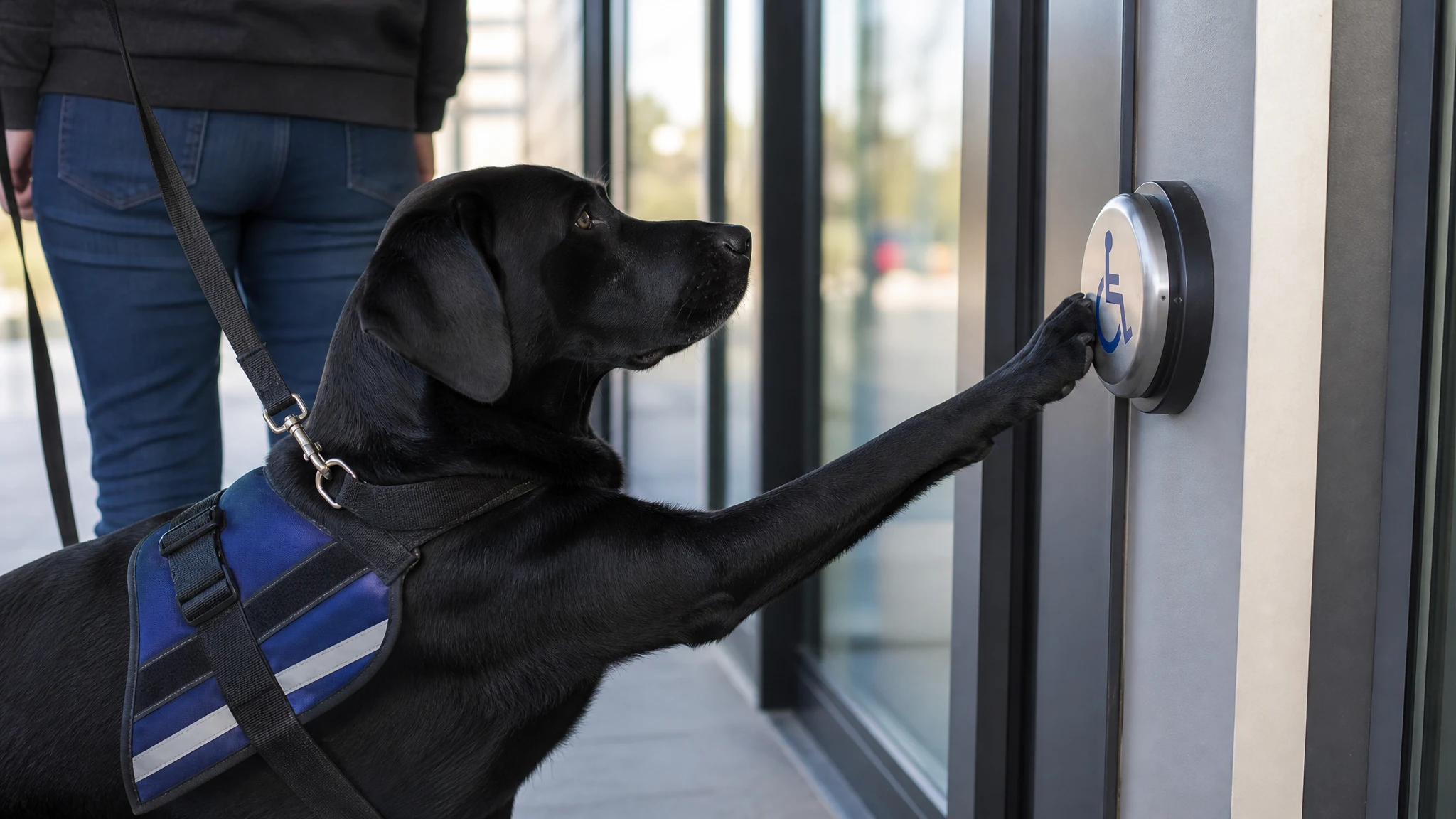
- Mobility disabilities: retrieving dropped items, opening doors, bracing so the handler can stand, or pulling a manual wheelchair.
- Seizure disorders: staying with the handler during a seizure and fetching help or a medication kit, as trained.
- Diabetes and other medical conditions: alerting to changes the dog has been trained to indicate, or bringing supplies.
- Psychiatric disabilities, including PTSD: interrupting repetitive or harmful behavior, turning on lights and checking a room, creating space in a crowd, or applying calming pressure on cue.
In every case the handler has a disability, and the dog does something specific about it on cue or in response to a trained signal.
The Public Access Test Is a Benchmark, Not a Law
A service dog public access test is a structured check of how well a dog behaves in public places. Assistance Dogs International (ADI) publishes a public access standard that many programs and owner-trainers use as a guide.
It is a training benchmark. The ADA does not require a dog to pass it, and the ADA has no required certification or official registry. Passing a test does not create legal rights, and not taking one does not remove them.
The test is still useful. It gives you a clear list of skills to build and a fair way to judge whether your dog is ready for busy places. For the current ADI test items and scoring, check with ADI directly, because standards can be updated.
What You Need Before You Start
- A clear picture of your disability-related needs and which ones a dog could help with.
- Small, soft, high-value treats and your dog's regular meals for rewards.
- A flat or well-fitted harness and a standard leash. Use equipment that is comfortable and does not cause pain.
- A clicker or a marker word, if you like to use one.
- A simple training log, on paper or a phone, to track each task and each outing.
- Quiet practice spaces first, then busier ones: your home, a yard, then stores and sidewalks.
- Time. Task training and public manners usually build over many weeks and months.
Training should be humane and reward-based, in line with the American Veterinary Society of Animal Behavior (AVSAB). Do not use shock, prong or choke collars, alpha rolls, scruffing or dominance methods. They can raise fear and stress, which works against a dog that must stay calm in public.
Step-by-Step: Training a Task and Preparing for Public Access
-
Name the need and choose the task
Start with the disability-related problem, not the trick. Write down a situation, such as "I cannot reach items I drop" or "I freeze in crowded spaces." Then pick one task that addresses it, such as retrieving or creating space. Choosing a task that links directly to the disability is what makes it work under the ADA definition.
-
Break the task into small pieces
Split the task into steps your dog can learn one at a time. A retrieve, for example, might be: look at the item, touch it with the nose, pick it up, hold it, bring it to you, and release it into your hand. Teach one piece, reward it, then link the next.
-
Teach with rewards and a clear cue
Mark the moment your dog gets it right and follow with a treat. Add a verbal or hand cue only after the dog offers the behavior reliably. Keep sessions short, often five to ten minutes, and end on a success.
-
Link the task to the real trigger
Some tasks are done on cue. Others are done in response to something, such as an alarm sound, a rising heart rate or a stressful behavior. Pair the trigger with the task step by step. Work with a qualified, reward-based trainer if the trigger is complex or hard to recreate safely.
-
Build the core public manners
Teach a settle on a mat, a loose leash, a stay, and a reliable recall. Also teach the dog to ignore food on the floor, other dogs and people who want to pet it. These are the skills a public access test tends to look at.
-
Add distractions slowly
Move from your living room to a driveway, then a quiet parking lot, then a shop at a slow hour. Raise difficulty only when the dog is succeeding. If your dog is stressed, move back a step. Rushing is one of the most common reasons public work breaks down.
-
Practice the task in public
A task your dog does perfectly at home may fall apart in a store. Repeat it in each new place, with a reward the dog really values. Log what worked and what did not.
-
Run a practice public access test
Once your dog is steady, set up a mock test with a helper. Walk through doorways, pass other people and dogs, sit and settle at a table, and have the helper drop an object or create a mild distraction. Use ADI's current published standard as your checklist, and note any skill that needs more work.
-
Keep practicing
A public access test is a snapshot. Dogs need ongoing practice and rest. Review your log every few weeks, refresh tasks that are slipping, and retire a dog from public work if it seems stressed or unwell.
What Nevada Law Says About Access
Under NRS 651.075, a place of public accommodation in Nevada may not refuse admittance or service to a person with a disability because of a service animal. It may not charge an extra fee or deposit, and it may not require proof that the animal is a service animal.
Staff may ask the two questions that ADA.gov describes: whether the dog is a service animal required because of a disability, and what work or task the dog has been trained to perform. This is why being able to name your dog's tasks plainly matters more than carrying paperwork.
Staff may remove an animal that is out of control or poses a direct threat. NRS 651.075 also says a service animal may not be presumed dangerous because it is not muzzled, and handlers remain liable for damage the animal causes.
Nevada goes further than the ADA in one way. NRS 651.075 also covers a person training a service animal who is accompanied by a service animal in training, and it bars requiring proof that an animal is in training. NRS 426.099 defines a service animal in training as a dog or miniature horse being trained as a service animal. For more on access, training and where the rules apply, see our guide to service dogs in Nevada, training and access rights.
No registry, and a penalty for misrepresenting
Neither the ADA nor Nevada requires you to register or certify a service dog, and no state ID program turned up in the Nevada statutes. An online registration or ID card is not legal proof of anything. Under NRS 426.805, misrepresentation is a misdemeanor with a fine of not more than $500.
NRS 426.790 treats interference with a service animal as a gross misdemeanor. Beating a service animal is a category E felony, and killing one is a category D felony.
Housing and work
NRS 118.105 says a landlord may not refuse to rent a dwelling to a person with a disability solely because an animal that assists, supports or provides service to the person will live there. The landlord may require proof, which a health care provider statement may satisfy.
NRS 613.330(6) makes it an unlawful employment practice to refuse to let an employee with a disability keep a service animal at all times in the workplace.
Tips and Common Mistakes to Avoid
- Mistake: treating comfort as a task. If the only benefit is emotional comfort from the dog's presence, it does not meet the ADA definition. Train a specific action.
- Mistake: buying a certificate or vest package as "proof." There is no official registry. A vest may help the public understand, but it is not a legal requirement and not legal proof.
- Mistake: skipping to busy places too soon. A dog that is overwhelmed learns the wrong lessons. Build distractions in small steps.
- Mistake: relying on corrections. Pain-based tools and dominance methods may suppress behavior without teaching it, and they can harm the dog's trust in you.
- Mistake: treating the public access test as a legal pass or fail. It is a benchmark. Use it to find gaps in training.
- Tip: practice your two-question answer. A short, calm reply such as "Yes, she is a service dog, and she is trained to retrieve dropped items" is usually enough.
- Tip: keep rewards varied. Mix treats, praise and play so public work stays rewarding.
- Tip: watch the dog's body language. Yawning, lip licking, a tucked tail or a refusal to eat can be signs of stress. Take a break.
What to Expect
Results vary with the dog, the task and the handler's consistency. Many teams find that a simple task such as retrieving can take several weeks to teach, while public manners and complex alert or response tasks often take months. Some dogs may not be suited to public work at all, and that is a normal outcome rather than a failure.
With steady, reward-based practice, a dog may become more reliable in public, and a practice public access test can help you see where it is ready and where it is not. No method guarantees that a particular dog will qualify or succeed.
If you have a problem with a business in Nevada, the Nevada Equal Rights Commission (NERC), part of the Department of Employment, Training and Rehabilitation, handles public accommodation complaints under NRS 651.110. Check with the agency for current contact details and filing deadlines. This article explains the law in general terms and is not legal advice.
Sources
- ADA.gov, Frequently Asked Questions about Service Animals and the ADA
- Nevada Legislature, NRS Chapter 651 (public accommodation, NRS 651.075 and 651.110)
- Nevada Legislature, NRS Chapter 426 (definitions, interference and misrepresentation)
- Nevada Legislature, NRS Chapter 118 (housing)
- Nevada Legislature, NRS Chapter 613 (employment)
- Nevada Equal Rights Commission